Friday, July 10, 2015

Humans


The most important piece of advice I've ever received, when it comes to telling story is this: Get to it. Don't futz around. Don't dwell on your themes or your social commentary. If you got a story, whip it out, let's see it. If you have a journey planned, I better be on the road by the time Episode One ends. In fact, I better have already made my first pit stop for snacks and a toilet.

I will admit that Humans is not a perfect show, but it certainly gets to it, right quick.

Humans is a show about robots. It is set in an alternate reality where robots are so advanced that they can perfectly copy humans. They lack original thought or sentience (some exceptions may apply), but they are capable enough to have replaced humans in most manual labor jobs. The show follows several characters over several different points in time. The main character, Anita, is a nanny-bot seeming to develop sentience. But the show doesn't linger on the mystery of whether or not she can think for very long. Instead, it jumps into the past where she and a few other robots are on the run.

Escaping from linear storytelling is just about the best choice the show makes. Instead of getting bogged down in any one stage in this journey, we get the best of all worlds. We see Anita beginning to develop sentience in a domestic scenario. We see how the various members of the family react to her. But just when the show starts to circle the drain, we jump to a high stakes fugitive plot, with plenty of seedy underbelly. And, just when that gets a little pointless, we get a side story of a man who can't say goodbye to his out-of-date robot, because it is the last vestige of the old man's dead wife. And, by jumping around, the show allows the audience to ruminate on grander themes, to read between the lines.

But it's not just the plot that kicks in at high gear. The show wastes no time showing off its stylistic ace in the hole: The Uncanny Valley. This is a term that is meant to demonstrate the level of discomfort people feel when presented with things that are almost, but not exactly, lifelike. Japanese androids, the animated films of Robert Zemeckis, and Jason Derulo, all fall into this category, where by being so close to human, but not quite there, we are uncomfortable with their presence. Somehow, through computer effects, practical effects, and very good acting, this show has managed to put actual people into the Uncanny Valley. So much of the tension of the domestic scenes is created by the very presence of a woman who is not quite human. And this is why the show's name - Humans - makes sense. The whole purpose of the show is to present the audience with a human and then tell them over and over, "this is not a human." The cognitive dissonance created makes for a perpetual unease, that occasionally boils over into quasi-terror.

I should point out that Humans is not perfect. Oftentimes, this episode opts to explain a philosophical concept, rather than demonstrate it. A few early plot points are trampled during the mad dash to narrative gold. And the family doesn't stray too far from stereotype. But most TV families are boring. At least this one has a nightmare robot creepily cleaning the table while they eat.

B+ 

Mr. Robot


What is the primary function of a first chapter? I've been thinking about this a lot. Whether it be TV, comics, books, or whatever kind of story you are telling, what must your introduction accomplish, to be successful? I've read a lot of ideas on the subject. I've heard the first chapter's function is to bring the audience into the world, introduce the characters and themes, or establish the story's hook. But for every proposed purpose, there is a counter example. There is only one function that every good Chapter One must accomplish, from which all other qualities derive. It is this: Chapter One must make you want to read/watch Chapter Two.

I lay all this out because, while Mr. Robot has many merits, the pilot doesn't make me want to watch Episode Two. And that's a shame because this is a good episode.

Mr. Robot is a show that is not actually about a robot. It's about a young man named Elliot (Rami Malek) with exceptional computer skills and very poor personal skills. Elliot is a cyber security specialist by day and a hacker vigilante by night. He finds people who he suspects of being wicked in some way, invades their cyber life and eventually either blackmails them or just turns them in to the authorities. He also clearly has a host of mental disabilities including, but not limited to, Social Anxiety, Delusions, Autism, and Depression. He then meets the eponymous "Mr. Robot" who is actually just Christian Slater. "Mr. Robot" brings Elliot into a ragtag group of hackers bent on crushing the world's largest corporate conglomerate, which is actually called Evil Corp (not kidding). Elliot agrees to take on the fight because of course he would, being that he is a disenfranchised hacker, and in the end, the battle begins.

That's about it. The good guys and bad guys are established. The world is established -  a deeply subjective world, as it seems we are seeing it through the eyes of our delusional hero. And the hook - the most accurate portrayal of computer hacking to ever grace the small screen - is thoroughly established.

But there are fundamental cracks in all these ideas that undermine the exceptional tone and thoughtfulness of this episode. As for the characters, Malek is a gem who manages to thoroughly captivate us from the second he appears on screen. But Slater is not really the best foil. He's supposed to be a charismatic leader, but he comes across as smarmy, and little else.

The idea of a world seen through the eyes of a conspiracy nut is interesting, but also really boring. The show is chock full of tirades against the modern world that lack the eloquence and passion of say, Do the Right Thing or The Social Network. These tirades wind up feeling more like a checklist of things young disenfranchised people might hate.

And then there's the hook: the hacking. I am pleased that we've moved beyond the game of Snood that used to pass for hacking in fiction, but this show still fumbles trying to find how best to mine drama from computer hacking. One scene in particular in Mr. Robot puts Elliot in a server room, frantically trying to switch to a backup server before the primary cuts out. This scene is punctuated with lines of code and a blinking circle. No amount of dramatic music is ever going to make this scene anything but a guy on a laptop typing while a circle on a monitor blinks. It's just not very dramatic. No one's life is in danger. The stakes are abstract, ethereal. Other scenes use hacking more effectively, as a way to search and snoop. A fact-finding scene, or even a world-establishing scene. But with most of the high points of the story being computer related, the show winds up stuck with limited stakes. I'm not sure what will happen if our hero fails, and I'm not sure I care.

It should be mentioned that this is a USA show, and it is a massive step in a new direction for the blue skies network. The show is brooding and thoughtful in a way that's not entirely annoying. There is lots of sex and drugs and other things that would upset people looking for reruns of Burn Notice. But in other ways, the show stays true to its USA roots. Slater at one point says that the best way to take down Evil Corp is one executive at a time, outlining the show's procedural hook. Every episode we'll be taking down another Wall Street villain. It's pure fantasy, and I'm not sure if the show is willing to engage with the realities of what they are doing. I doubt we'll ever get a shot of the mean executive they framed, in prison, weeping, alone in the dark, with only the fading memories of his children's faces to keep him comfort.

I'm not sure how to give a letter grade to this episode as it was very entertaining, yet I doubt I'll ever watch Episode Two. It failed as a pilot, but it succeeded as a brief venture into the world of cyber warfare and crushing loneliness.

I'll give it a B.

Sunday, April 12, 2015

American Odyssey


Before I get into this review, I must mention that Anna Friel makes any chance of a neutral, objective review completely hopeless. When I see her face, my critical brain shuts off. It's not that she's sexy or provocative. She's attractive, in a gravitational sense. She absorbs. She captivates. She is the jailer of my solitary focus. I am not watching a TV show when she appears on screen. I am eating a feast.

So, today, I'll be doing my best to review the parts of this pilot that do not feature Anna Friel. American Odyssey has several interweaving plot lines having to do with terrorism, business, information, all glossed over with a heavy coat of conspiracy. When an American Special Forces team find and kill a famous terrorist leader, they happen upon some information that seriously incriminates a U.S. company. They are promptly wiped out by a private military outfit. All except the Special Forces translator, played by Friel, who then attempts to make her way home in a hostile land. Along the way, she makes expressions with her face that make me feel like my insides are turning into warm tea...

Anyway, across the globe, the show's other, less delirium-inducing characters  are a collection of lame stereotypes. A bumbling nerd hacker who lives with his mom. A rich Lawyer struggling with his conscience. An Occupy Wall Street protester in a fashionable hat who talks like a protester who has been asleep since 1969. I don't like any of these characters very much. And what's troubling is that the show doesn't seem to like them much either. When the Occupy Wall Street kid comes home with a girl who says she's a reporter for Time Magazine, the show cuts to ominous shots of her looking suspicious. There's no ambiguity here. She's a fucking spy. You know it, he doesn't. This just makes him look like an idiot.

By the end of the episode, the writers spill the beans on the whole conspiracy. You know who the bad guys are and why they are doing what they are doing. There's no mystery any more and there are eight more episodes.

The filmmakers behind this episode are crafting a reverse magic trick, where you see all the strings and mirrors, and the characters in the show play the confused audience. But, much like standing back stage during a magic show, it's not very entertaining.

All in all, I can't say this is a good show. I can say, for sure, that I will watch every episode. Because they have not yet invented drugs as powerful as watching Anna Friel act.

C-

Friday, April 10, 2015

Daredevil


A lot of people nowadays forget that most of Shakespeare's plays - nearly all of the great ones - were adaptations. He had little interest in making his own stories from scratch. He would take old legends, old poems, old historical records, and he would insert two things: beauty and ambiguity. Take the story of Amleth, a classic story of royal betrayal and revenge that was then retold by Shakespeare as 'Hamlet,' a story of introspection and inaction. The writing is so stunningly effective, it is over-quoted, four hundred years later. Now, all of this is not to say that Daredevil is Shakespearean in quality. It isn't. I'm simply saying that there is nothing wrong with retelling old stories. But to retell a story well, you'd better insert some beauty and some ambiguity.

So we arrive at Daredevil, another phase in Marvel's campaign to dominate the world. It is a retelling of a comic book series that debuted in 1964 about Matt Murdock, a blind vigilante. As a child Matt is blinded by some radioactive chemical which gives him supernatural hearing and olfaction. By day he is a lawyer and by night a crime-fighter. The first two episodes do little to establish his impetus for crime fighting (though it's not hard to guess). Instead they focus more on what happens after he decides to put on a mask. From this point, we meet the allies he makes - a new assistant for his law firm, and a street-wise nurse for his crime fighting - as well as the bad guys he will face as the show progresses - a murky establishment of criminals and business men. It's all lifted pretty faithfully from the comic. So, how does it fare as an adaptation? We'll give it the Shakespeare approach and talk about beauty and ambiguity.

When it comes to beauty, the show really knocks it out of the park. I was initially skeptical about Daredevil. It was being pitched as "gritty" which, these days, means "monochromatic and humorless." And I didn't think I could stand to watch a 13-episode series with the color pallet of a high school cafeteria. Luckily, the show has a lot more to offer in terms of visuals. For example:


In Daredevil, windows tell the story. Scenes are usually set in front of large windows. These windows tell you something about the character standing before them. For example, Matt Murdock, the blind vigilante, never sees whats outside the window, so neither do we. He is lit by stained glass which obscures the details, but still provides the putrid yellows and sickly greens coming from outside, symbolizing the danger and horror of the city.

When Daredevil launches into its action scenes, it aims to impress in a way that is rare for TV. The fights are frenetic and thrilling, occasionally slowing down to give you a glimpse of how a blind man fights. I was most impressed with how painful every fight looked.

But, while it nails beauty, when it comes to ambiguity, the show falls short.

In the second episode, Claire Temple (Rosario Dawson) is introduced as a moral observer to Matt Murdock's crime fighting ways. She is aware of his actions, and understands the positive outcomes, but she also calls into question his unethical methods. This kind of character is really important to thoughtful art, as you never want your audience to be trapped by the world view of your main character, especially when his world view is a little skewed. So she adds a dissenting voice. But, sadly, as the episode goes on, she eventually puts her morals aside and joins in on torturing a bad guy. This is a shame as she could have infused the episode with a lot of ethical complexity.

Matt Murdock is perfect as an ambiguous super hero. Throughout the show, the bad guys aren't always street thugs. Some of them are cops, or businessmen in suits. But, like lady justice, Murdock is blind, judging you for your actions only. Sadly, the show doesn't fully capitalize on this. None of the cops in the show are actually bad. They are either crooks pretending to be cops, or a cop forced to do bad stuff to save someone else.

In spite of its shortcomings, Daredevil is ambitious in a way that other Marvel shows aren't. While Captain America fights for the fate of the world, Matt Murdock is knocking out a fat guy in a recliner. Daredevil knows there are aliens and gods fighting above us, but Daredevil doesn't care. It may not be Hamlet, but above all else: it is true to itself.

A-

Monday, March 9, 2015

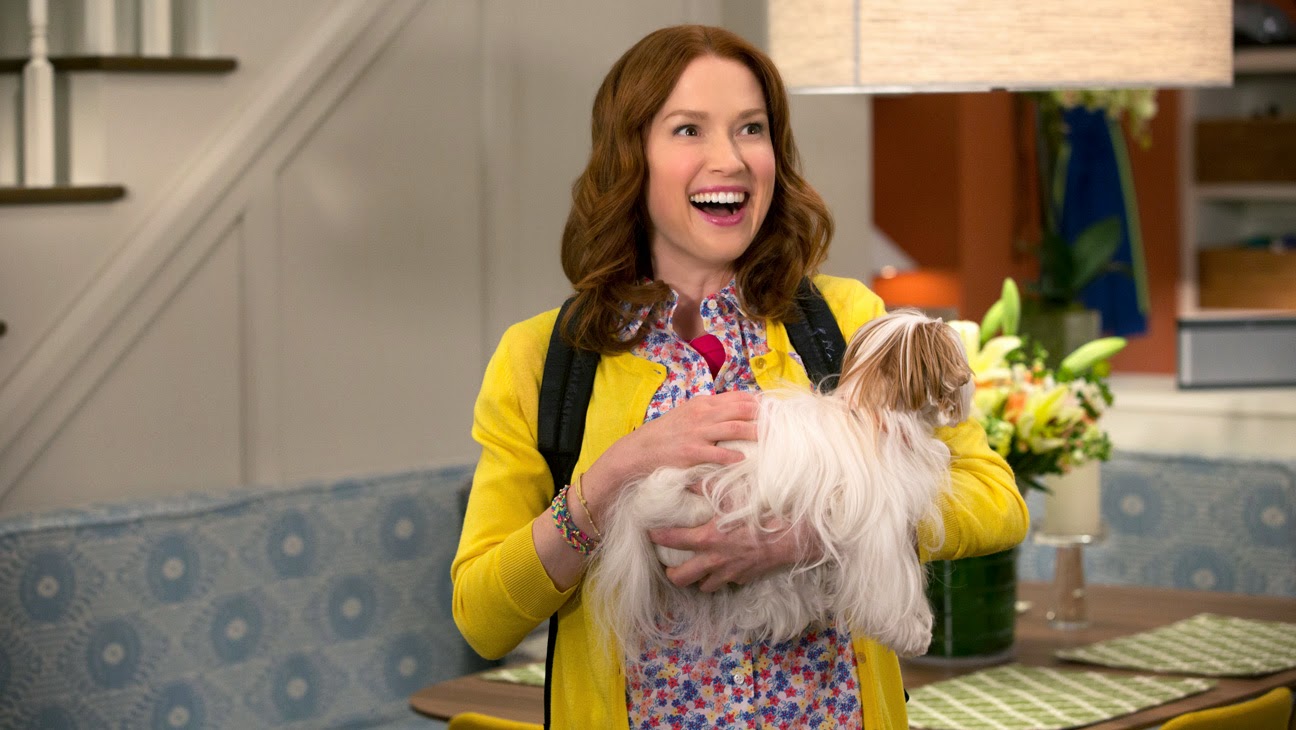
The Unbreakable Kimmy Schmidt


For me, hell is being trapped in a sitcom. No matter what I do, no matter how hard I rattle the bars of my cage, nothing will ever change. It's for this reason that I think sitcoms have become largely pessimistic over the last few decades. Back in the 1950s, the American Dream was one of routine. Get a job, get a family, never advance or age, just work, and impart parental advice. A whole host of shows followed on this wave. Sitcom America was a place where everyone was happy, no one ever learned from their mistakes and nothing ever changed. But, after decades of Father Knows Best and Leave it to Beaver, American audiences finally caught on. The American Dream was... creepy. And rather than upend this comedy format they'd become so attached to, American TV writers began subtly poking holes in the sitcom standard. Now, no one learned from their mistakes, nothing changed, and life was a little sad.

These days, life is very sad if you are a sitcom character. Whether you are trapped at a community college forever, or navigating being a depressed single dad, sitcoms are about a time in your life that you are happy to recount to others, but are glad you are not experiencing anymore. Which is why The Unbreakable Kimmy Schmidt is kind of amazing.

Tina Fey and Robert Carlock's new Netflix sitcom is the most optimistic show I have seen in years. It is about a cult survivor who suddenly decides to move to New York City with nothing but a middle school education and a supernaturally positive attitude. It could be a horribly depressing kind of show. A show where the naive, broken girl,  is slowly crushed by the real world. But that's not the case. This is a show about putting your life together. About diving into the deep end to learn how to swim. Unlike most sitcoms, The Unbrekable Kimmy Schmidt, is about the most important year in Kimmy's life. It's exciting, if a bit overwhelming.

Ellie Kemper is amazing. With a kaleidoscope smile, impressive physical momentum, and endless double-edged comebacks, she makes naivete look cool. And the supporting cast is a blast. Jane Krakowski is basically cut and pasted from 30 Rock, which is in no way a bad thing, as Tina Fey loves writing about desperate women entirely out of touch with reality. Carol Kane is an utterly terrific, under-the-radar comedian. She's relegated mostly to brief exchanges on a Brooklyn stoop, which is perfect for her kind of humor. Tituss Burgess is doing his fabulous thing, which is fine, I guess. I see how his character fits into Kimmy's life, but his plot lines on their own are fairly weak.

On the whole, I can't recommend this show enough. It's optimistic without being bland. It's heartwarming without being cloying. It's shockingly dark at times without ever being cynical. And even when the jokes aren't landing as hard as they could, I'm pretty sure watching Ellie Kemper smile will add years to your life.

A-

Tuesday, February 24, 2015

In Defense of the Oscars


I’m taking a break from format to talk about something that’s important to me: The Oscars. However, I do not plan on defending the tedious, frequently insulting, sometimes blissfully absurd Oscar ceremony that occurred last Sunday. I’m here to defend the Oscars as an institution not as a three-hour snooze fest.

Why defend the Oscars?

The Academy gets a lot of hate. This is probably a reaction to the amount of love the Academy showers itself with. It’s hard not to lash out at a group so notorious for self-congratulation, but I think a lot of the flak the Academy gets is due to a fundamental lack of understanding in what purpose the Academy actually serves. They are not here to pick the best picture of the year. They are here to aid the process of natural selection.

What does film making have to do with natural selection?

To understand the Academy Awards and what they do, you should look at filmmaking as a species that is evolving. Evolution happens due to natural selection. Some external force must shape a population for it to change. This force enacts change by killing off individuals unsuited for survival and rewarding the stronger individuals by allowing them to reproduce. Filmmaking works in a similar way. You begin with a big pile of scripts, most of which will not come to fruition. When a script finally does become a movie, it must “perform” at the box office. This performance is objectively qualified via revenue. If the film is successful at the box office, other films will attempt to copy the original film in some way.

This is how films reproduce. Instead of a mom giving birth to a child, Twilight gives birth to a sequel, but more indirectly, also gives birth to The Hunger Games. Not a sequel, but clearly a movie trying out the same formula in the hope of drawing an audience. In this way we can see certain films birthing dozens of other films, sometimes entire genres (Dirty Harry, The Matrix, It Happened One Night). These are biologically speaking, very “fit” members of their species. Other films such as John Carter or The Lone Ranger are weak members of the film species. They perform poorly and thus they do not get to reproduce. There will be no Lone Ranger sequel and Jerry Bruckheimer will have a hard time getting his hands on another 150 million dollar budget.

You could look at whole genres as genes that were adaptive for a while but then quickly lost their competitive edge. For example, back in the old days, Westerns were everywhere. They were the most popular genre for men in the United States. But after a while, just like in evolution, the landscape changed, and The Western couldn’t compete with the Cop Drama. And, soon enough, movies that spawned from John Ford and Sergio Leone began dying loudly at the box office. You could see Lone Ranger as the last of its species, wiped out by natural selection. You could also see it as a terrible film, but that’s beside the point.

Much like in evolution, there is no higher order in the film world. There is only the struggle, which as a whole produces a cohesive form, but individually, is a disorganized, desperate fight for survival.

So where do the Oscars fit in to all of this?

In natural selection, what you sometimes get is a species developing two separate ways to survive and reproduce, both evolving simultaneously. Take, for example, the Giant Cuttlefish. For a male Giant Cuttlefish to mate, it must find a female and fight off the other males, thus ensuring the strength and ferocity of the species’ males. But, there are also smaller male Giant Cuttlefish, who have discovered another strategy, whereby they pretend to be a female. The males like to collect as many females as they can. So the sneaky male joins the bigger male’s harem and quietly mates with all the ladies, right under the protective larger male. In this way, natural selection is ensuring that the strongest and the smartest Giant Cuttlefish get to reproduce.

The like Giant Cuttlefish, The Academy Awards have provided an alternate way to reproduce. Our previous metric for the success of a film was its box office performance. But if films today only copied the formulas of high revenue films, then we wouldn’t have films by Wes Anderson or Spike Jonze. Films that are showered with awards also spawn copies, despite sometimes performing below average at the box office. This is because the producers making these films believe the Oscars have a value that is higher than money. The Oscars represent the respect of their peers. And thus producers will make films that may not make much money in the hunt for an Oscar. For example, look at the film The Hurt Locker, which performed decently at the box office, but not great. Regardless, it won all sorts of Oscars. And you could see a film like American Sniper as a child of the Hurt Locker.

In evolutionary the Academy Awards provide “genetic diversity.” The reason every human doesn’t look the same and the reason one Cuttlefish sneaks while the other fights, is because the survival of a species is dependent on diversity: multiple approaches to a single problem. If only the monetarily robust films survived and spawned copies, then the film industry would be a depressingly one note affair. Take a look at the top grossing films of 2011, four years ago.

1              Harry Potter and the Deathly Hallows – Part 2    
2              Transformers: Dark of the Moon             
3              Pirates of the Caribbean: On Stranger Tides        
4              The Twilight Saga: Breaking Dawn – Part 1           
5              Mission: Impossible – Ghost Protocol    
6              Kung Fu Panda 2              
7              Fast Five             
8              The Hangover Part II      
9              The Smurfs        
10            Cars 2

Now imagine that every film made in the year 2014 was a copy, or a knock off of one of those films.

Instead, we saw Damien Chazelle’s bizarre torturous look at music school, Wes Anderson’s pop-up-book ode to chivalry, and Richard Linklater’s twelve-years-in-the-making, nonchalant foray in existentialism. And we saw these not because Wes Anderson is a genius. We saw them because a producer saw his script and thought, “This may not make much money, but it’s kind of similar to all those arty movies that win Oscars, so I’m going to make it because I would like a golden statue of a naked man.”

Birdman was kind of lousy and pretentious. Does this mean we’re going to be seeing more lousy pretentious films?

Yes and no. Birdman is by no means perfect. The dialogue is on the nose and Iñárritu, bless his heart, cannot structure a movie to save his life. But that’s not what producers were looking at when they greenlit Birdman. They were looking at its core components. It is artistically extravagant, it is metatextual, and it invites deeper readings. These are qualities in a script that do not make money. But they are qualities that get Oscars. And thus they are qualities that future producers will be looking for when they greenlight films. This may lead to a bunch of pretentious films, sure, but it could also lead to the next gem from Charlie Kaufman. It’s hard to say. In this way, even a terrible best picture winner is not always a bad thing. Crash is a bad film by any standard, but its core components have value. Meditations on a theme, structural creativity, discussions of race, these components (which were in no way invented by Crash) have since found their way into other better films, which may have been greenlit because of their Crash-ness.

This is not to say that the Oscars can do no wrong. Nominating a film like Avatar, which has already been rewarded enough by the box office, in no way promotes genetic diversity within the film world. And consistently disregarding certain genres will eventually drive talent away from those kinds of films. But, the next time you hear someone say, “X was robbed!” referring to a best picture nominee, ask yourself, what were they robbed of? Did they make money at the box office? Did they get an Oscar nomination? If so, then we’ll see more from that well, and really you’re just complaining because a producer, who you don’t actually know, didn’t get a naked man statue. And the next time you hear someone say, “The Oscars don’t matter,” remind yourself of what the world would look like if movie making was only about money.

Friday, January 9, 2015

Mozart in the Jungle


It's tough writing reviews for pilots airing on Netflix or Amazon or any venue that presents you with every episode all at once. In one sense, I think a show really benefits from being able to craft a full season in one go. But, on the other hand, it means that the pilot frequently feels less like the show's mission statement and more like a first chapter. I don't see the point in reviewing a first chapter. That being said, Mozart in the Jungle does a lot of good work laying out the bizarre world of hardcore partying classical musicians. And it's a fun little world.

Based on the book, Mozart in the Jungle is about the strange inner workings of the classical music scene in New York City. A lot of humor is squeezed out of the contrast between the classical and the contemporary: downing shots between rounds of an oboe vs. flute play-off.

The show is written in part by Roman Coppola and Jason Shwartzman - and they bring their love of being young and understated in the big city - but their dialogue feels somehow muted in this setting. For all their musical virtuosity, the characters are a little one note. Everyone is surface level quirky, as opposed to Roman's usual deep inner quirkiness. The directing is odd. There's no consistent stylistic voice. At one point, the show slips into bizarre impressionistic visuals, at another point it uses 30 Rock-style cutaway gags. It keeps you on your toes, for sure, but it's also distracting and makes the whole episode feel disjointed.

All in all, if you like Girls and want something like that, but set in the New York classical music scene, you might dig this? I don't really know.

B

Empire


A word of advice: if you are going to remake King Lear, and set it in the world of hip hop, don't have one of your characters say, "What is this, King Lear?" It's not cute, it's lazy.

So, this is basically Dallas, but with hip hop instead of Country. And really bad hip hop, too. Every time someone plays a track and goes, "That's nice," I wonder if this is secretly a show about deaf people. But, to be fair, Timbaland isn't going to write his best stuff for a network drama. He's got Jay-Z on the other line. So, ignoring the horrible music this show made me listen too, I walk away a little mixed.

First, the good stuff: Taraj P. Henson. This woman is not messing around. She can chew the scenery and then, in a split second, become relaxed and comfortable. She sinks her teeth into the material, even if the material is paper thin. I love it that Henson makes the decision not to play her character like a madwoman, but like a woman who pretends to be mad. Being unpredictable gives her power, and she uses that power. More good stuff: addressing hip hop homophobia. This is a subject that deserves a little inspection and I appreciate the show for not pushing the gay artist into the background.

Now, the bad stuff: Terrence Howard. I like the guy, but this is a phoned-in performance. He delivers every line like he's asking a stranger for directions. He has been given a rich and complicated character who could be a villain or a tragic hero, depending on the performance, but Howard just plays him like a cameo. He is almost always framed in the middle of the scene, and he's like a black hole, so utterly devoid of all content that he destroys the scene around him. More bad stuff: the writing. Every scene was so transparent. Two characters arrive at a location, explain what they want, scheme an obvious plot and then move on. At a certain point, as long as I know who's in the scene, I know exactly what will happen.

One thing I can say for Empire's pilot is that it's clearly holding nothing back. Sometimes, pilots for epic soapy dramas can start a little piddling, but this isn't the case for Empire. There's lust, betrayal, and murder, all in the first episode. But this also demonstrates Empire's weakness. The show has shown its hand and there's not a whole lot to bet on.

B-

Thursday, January 8, 2015

Agent Carter


I think it's possible to appreciate the past without sliding into nostalgia. Every generation had a fresh new view of the world. I don't buy the whole "simpler times" bullshit. But I do think there were remarkable times. There is something charming in the birth of cinema, the first shaky steps we took into the visual medium, when everything was fresh and new and tying a damsel to a train track was down right inspired. This admiration for our storytelling roots is what gave us Raiders of the Lost Ark, every Wes Anderson film, and now, Agent Carter, the newest addition to Marvel's media blitzkrieg.

Agent Carter follows the thrilling adventures of Peggy Carter, who works for a mysterious government agency in post WWII America. The fact that she is Captain America's ex-girlfriend, or that this all somehow fits into the ever-expanding Marvel cinematic universe is thankfully pushed to the background. What matters here is the thrilling adventures.

The first episode features exploding orbs, lethal hitmen with removed vocal chords, shady deals at fancy balls, and sci-fi technology made from typewriters and old razors. Agent Carter grabs a big armful of old school pulp storytelling, slips in some modern ideas on gender, and drops it in your lap. It's a blast (sometimes literally) to watch. And it has at its core a woman with enough emotional depth to keep the whole thing grounded.

If I had to pick what I liked the most about this pilot (which I'm having a very hard time doing), it would have to be Hayley Atwell's performance as the titular character. She is magnetic. And she's been given a character that makes perfect use of her blinding confidence as an actor. Carter is tough and practical, but what stands out for me is that she has no tacked-on flaws. The writers have smartly avoided giving her a run-of-the-mill weakness. She's not an asshole. She's not a mess at home. She's polite and kind, never relenting an inch in a world that is not particularly fair to single women in the work place. And she should be perfect. This is Captain America's girlfriend!

I also have to point out how much I love this pilot's approach to sexism. If you're going to make a period TV show, it's hard not to address this unfortunate part of American culture, especially in late 1940s America, where men were re-entering the work force and displacing thousands of women. But there's a line you have to tow: you can't ignore how sexist America was, but at the same time, you've got to make a point beyond "sexism is bad." I sometimes get very bored with Mad Men after the nth scene showing me how much it sucked to be a woman in the 1960s. This show proposes a simple solution: instead of sexism being the point of the show, it is simply one more obstacle standing between Agent Carter and saving the world.

A

Wednesday, January 7, 2015

Galavant


I like Dan Fogleman for the simplest of reasons: He is funny and he rarely infuriates me. If you are looking for something funny that won't make you terribly angry, then don't bother with the rest of this review. You can go watch Galavant and enjoy yourself.

But, if you are looking for anything deeper than a hearty chuckle and Timothy Omundson's soft shoe, then I fear you will be uniquely disappointed by Galavant. The story is fast paced and the songs are well written (because they're written by Alan Menken and Glenn Slater), but in the end, the show doesn't seem to have anything to say. It picks apart the cruelty of the medieval fantasy genre, but only for the purpose of a few laughs, and nothing else.

There is one moment in the beginning that borders on subversive when Galavant (Joshua Sasse) comes to rescue his girlfriend Madalena (Mallory Jensen) from being married to the wicked King Richard (Timothy Omundson) and she politely declines. This is something we rarely see in fantasy: in a time rife with poverty, war, and the plague, things like wealth and security are far more important than love. And the show could have made Madalena a very relatable character, but instead, she is portrayed as a greedy shrew. Ultimately the show condemns her for wanting something other than a man.

Galavant's horrible girlfriend is only one example of the many ways this show sashays to the edge of subversion before immediately backing away. And again, I must stress, this is not a condemnation of the show's production, acting, or plot. The show is functional, occasionally delightful. It's simply pointless. Galavant may wish it were Monty Python and the Holy Grail, but without a stronger effort to attack established fantasy cliches, Galavant will surely end up as the kind of tale that Monty Python was making fun of in the first place.

B-

Monday, December 22, 2014

The Legend of Korra Teaches Us How to Write a Good Finale


I made the whopping mistake of writing my best episodes of twenty fourteen list before the final episode of The Legend of Korra aired, which wound up being beyond satisfying. But, I have been meaning to write a little about finales, so I'm going to take this mistake and turn it into an opportunity.

The Legend of Korra gave us the best finale of the year and probably one of the best series finales I've ever seen. I'll get into why that is in a little bit. First I want to talk about bad finales and why they are so awful.

A TV show that you regularly watch is like a friend. Because your friends, and all the other people in your life, are just a collection of stories that form an identity. And when a show is over, when the stories cease, its life is over. A series finale is sort of like a funeral. It is a celebration of the show's identity, and a wrapping up of all the stories it told. And, just like in life, it's hard to find meaningful closure. Rarely does anything wrap up with a nice tidy bow on top. And more often than not, a show wants to find more meaning in its finale than there has been in all the episodes that preceded it. Sometimes, the show simply cannot let go. It doesn't want to die, and it rages against the dying of the light, until it is a quivering husk of what it once was.

So, here are the big mistakes that finales make, as a list, because the internet gods demand lists.

1. "Meant to Be"


This is where a romance that worked at the beginning of a long show - then due to complications fell apart - suddenly appears out of nowhere at the end, because the writers seemed to think that these characters were "meant to be." Poppycock. No one is meant to be. People are meant to be happy, not bound by fate to each other because their names appear in the opening credits.

2. "It Was All A Dream"


Maybe in the end it isn't all a dream but instead an analogy, or a vision, or a supernatural trek through some pan-religious purgatory. It doesn't matter. Don't make your own show's story irrelevant. Don't take all the death, the pain, the heartache, and make it all for nothing. 

3. "Aren't We So Awesome"


If you love a show and you love the characters, the worst thing you can do is make some last ditch effort to remind us that all the characters are cool. We're watching the finale, which means we don't need convincing to watch the show. There's no point trying to sell us on a party we're already attending.

4. "Deus Ex Machina"


You got a problem? A big one? One that you have spent a whole season, maybe longer, trying to solve? Well luckily for you, some guy from another show has an amulet for you or some stupid shit like that and "Tadah!" problem solved.  

5. "Rewards/Punishment"


This is a tricky subject, but it's an important one. When a show is over, it's over, so any message you leave us with is the last one you get. So watch out for who gets to live happily ever after and who gets punished. It doesn't matter if a character is the hero, if he kills hundreds of people and gets a happy ending, then the show is tacitly approving his behavior.

6. "And Then They All Went On To..."


A good finale leaves us wanting more, not thanking the gods that this will be the final story the show gets to tell. Which means epilogues are a tough sell. We know these characters - because we've watched them for years - so if you tell us what happens to them in the future, we are left thinking either, "Why did you mention that," or, "That would never happen." As a story teller, you take us from A to B to C. You can't just skip to Z and expect us to be on board.

--------------------

Suffice it to say there are a lot of ways to mangle the last chapter of your show, even if it was damn good right up until the end.


So now we arrive at The Legend of Korra. (Sorry, it took a little while.) This is a perfect finale. I mean perfect. No contrived rekindling of old love, no frustrating epilogue, no Deus Ex Machina. The story wraps up in both an epic and intimate way, the themes become laser focused (pun intended), and, in the end, we are left wanting so much more. 

What stands out most to me about the Korra finale is that it is all about love. It shows us the love of a father, a mother, a friend, a lover, and most importantly, an adversary. The Legend of Korra is unique in that villains are sympathetic. They have fears and grief and anger, and they are in need of love, just like the rest of us. So to conquer them, offer them compassion. It is a wonderful message, especially for the show's younger audience. 

What The Legend of Korra shows us in its final moments is an iconoclastic love. It is a love that doesn't involve men. Korra has, for a long time, been a bastion of girl-centric epics. Over the last few seasons, the men have become increasingly irrelevant to the story. This season featured Korra's first female 'big bad,' who was a mirror image of Korra, showing us how power and ambition are a recipe for both heroes and villains. The show's finale shed the "will they, won't they?" of Mako and Korra (a man and a woman), allowing a far more satisfying relationship between Korra and Asami (both woman). The love between them is ambiguous to younger viewers but clear as day to anyone watching closely. 


As the episode came to an end, I kept thinking of Patroclus and Achilles, two great heroes of the Illiad who fought side by side. History's first "Bromance." Their relationship was debatably platonic, undeniably epic, and has spawned a million copycats. Bonds formed in battle make for great drama. But it is a genre of story telling that has historically excluded women. The love between women has, for so long, been a tame domestic kind of love. It is a love that passes the time until the men come home. The Legend of Korra ended its fantastic run by showing that the love between women is a bond that saves the world.

Episodes You Should Have Seen in Twenty Fourteen

Reviewing TV pilots is, in some ways, a lot like evaluating a baby. It doesn't matter if he'll grow up to be Neil deGrasse Tyson, for now he's a drooling idiot who keeps trying to eat his own vomit. Pilots are often the worst episode of a show. On the other hand, sometimes a pilot is all a show has to offer and after the first episode the show just circles the drain. So I want to talk about episodes that were really damn good in 2014 that weren't pilots. Here's my list, in no particular order.


The Legend of Korra - "Ultimatum"


"As long as I'm breathing, it's not over."

Avatar: The Last Airbender was quite possibly one of the more important kids' shows of the last decade. It handled adult themes in a way that was kid friendly and yet in no way watered down. The Legend of Korra is an excellent companion piece to Avatar, but for a slightly older generation. And yet it has been shat upon by Nickelodeon, its third season getting released with no marketing, then pulled from air halfway through its run, available only via streaming on the Nick website. And it's a shame because the third season of The Legend of Korra is the best by far. The fourth and final season, airing currently, is not bad but pales in comparison. "Ultimatum" is a perfect specimen of what Korra does best. It's mostly fun and fast paced, and yet complex, highly political events underline every moment, every choice. On top of that, this episode has the best fight scenes I've seen on television ever, in my whole life. They are beautifully animated, amazingly choreographed and staged. The represent everything that animation can bring to the table with martial arts and they do so without ever forgetting about the stakes that underpin the action. I'm happy to be able to suggest many high caliber kids' shows (Adventure Time, Over the Garden Wall, Bravest Warriors) that parents can watch as well. But The Legend of Korra is the only kids' show this year that is constructing a cohesive lesson on how to view world politics. Also, girl power. So much girl power.

The Good Wife - "Last Call"


"What does it mean if there is no god? How is that any better?"
"It's not better. It's just truer." 

Speaking of girl power and politics... The Good Wife! There's nothing quite as shocking as killing a main character in a TV show. Since it is such an easy way to drum up emotion and pathos, it is frequently misused as a cheap trick to cover up poor character growth or to mine some drama out of an actor's contract dispute. Despite being a personal top ten drama for the last four years, this year, The Good Wife decided to kill off a main character for all the wrong reasons. And yet, from the ashes of this bad decision, the writers for The Good Wife created an hour of unwavering emotional free fall, the likes of which I have not seen since Buffy The Vampire Slayer ("The Body"). What is most fascinating about "The Last Call" is that there is a very serious discussion of atheism plopped down in the middle of what is otherwise a very focused story about discovering the meaning of a dead man's last voicemail. I find that atheism is often misrepresented in TV if represented at all. Atheists in media are always either acerbic intellectuals or nihilists. Rarely do you see a woman with a family, and a job that has nothing to do with science, who simply does not believe. There is no reason, no psychological framework, for her atheism. She just has no faith. And after decades of shows dealing with matters of faith, it's nice to see the other side represented with the same emotional care.

The Americans - "New Car"


"It's nicer here, yes. It's easier. It's not better."

And speaking of struggles with atheism... The Americans! I've started pitching The Americans as "Mad Men with a plot." I don't mean to disparage Mad Men. Sometimes finely crafted wandering is enjoyable. But every now and then, it's nice to see a little story between all that symbolism and critique. And story is where The Americans is king. Each season is a mile-a-minute spy thriller, loaded with heaping doses of critique and satire. What stands out about "New Car" is just how many themes it juggles. American commercialism, patriotism, the futility of vengeance, all culminating with the tearful breakdown of a child who was caught sneaking into the neighbor's house to play video games. And it's moment's like this, where the stakes are relatively low and the setting is intimate that the show strikes its hardest. Because no battle, no global event will ever hit as close to home as... well... home. 

Game of Thrones - "The Mountain and the Viper"


"People die at their dinner tables. They die in their beds. They die squatting over their chamber pots. Everybody dies sooner or later."

And speaking of the futility of vengeance... Game of Thrones! Where everybody dies and nothing has any meaning. This episode is Game of Thrones at its finest. The fight has edge-of-your-seat tension, breathtaking choreography and nightmare-inducing special effects. The writing is crisp, the meanings, layered. And while it ends with a woman shrieking in horror, it also features one of the show's most triumphant moments. Sansa Stark, after seasons of nonstop torture, emerges from the castle, clad in black feathers, powerful, magnificent. It won't last, because nothing ever does. But for a moment, Game of Thrones has given us the kind of triumph you can't manufacture with all the special effects in the world. It is the triumph you earn. The victory you claim by passing through the flames.

Rick and Morty - "Rixty Minutes"


"Nobody exists on purpose. Nobody belongs anywhere. Everybody's going to die. Come watch TV."

And speaking of everybody dying and nothing having any meaning... Rick and Morty! This is the funniest half hour produced in 2014, without a doubt. No contest. It takes what is essentially a throwaway sitcom B plot and turns it into a mission statement. And it couldn't have come at a better time. 2014 was a decidedly unfunny year. Robin Williams passed away, Bill Cosby probably raped a lot of women. It was hard to find new things to laugh at without feeling bad about yourself. But not Rick and Morty. Rick and Morty laughed at all the bad stuff and said, "Not only is it OK to laugh, it is the only thing you can do." Not since Douglas Adams has a show mined this much humor out of destroying all life on earth. And I can't think of a time in the history of television when nihilism has kept a family together. Life sucks, I know. Wubalubadubdub! 

True Detective - "Who Goes There"


"Enough with the self-improvement-penance-hand-wringing shit. Let's go to work."

And speaking of nihilism... True Detective! I think I loved True Detective a lot less than everyone else. It's on my top ten list, so obviously I loved it, just not as much as the guy sitting next to me. The main complaint I have with the season is that it isn't as profound as it pretends to be. But not being profound is not a bad thing. If you aren't telling us a story about life, but instead just telling us a story about two guys and a case, it frees you up in a lot of ways. So, why do I love this episode so much? Rust says it all when he says, "Let's go to work." This is the finest hour of True Detective. There is no pontificating, no discussions of emotional turmoil. Instead, Rust and Marty go off book and get into some serious shit. And boy is it thrilling. Everyone and their mother knows about the six-minute continuous take, but what is more interesting to me is the six minutes of no scripted dialogue in what is otherwise such a talky show. It is just action, tension, spectacle, and dread. And in the end, what makes "Who Goes There" such a good episode of television is that all that talk of "touching evil" is just talk. Finally, here, we see the lengths Rust is willing to go to for the truth, for his obsession. It is hypnotizing and deeply troubling. 

Hannibal - "Tome-wan"


"Whenever feasible, one should always try to eat the rude."

And speaking of hypnotizing and deeply troubling... Hannibal! I honestly cannot get over how beautiful this show is. It is unthinkably pretty. And it has the greatest score on television - all sloshing water and bending pipes with the occasional brush of piano strings, haunting and murky. Season one of Hannibal was a descent into madness, while season two is a game of cat and mouse between Will Graham and Hannibal Lecter. Of course, you're not ever sure who is the cat. Unfortunately, the season finale wraps up this battle of wills in a very stupid and clunky way, but right before the final episode came "Tome-wan," a moment of stillness and camaraderie between Will and Hannibal before it ends. Hannibal is very much like an epic poem of old, prone to hyperbole and meandering philosophical musings, filled with heroes, gods, and the Devil himself. But like all good epic poems, it makes a world of strange beauty that you cannot help but tumble into.

Fargo - "A Fox, A Cabbage, And a Cage"


"I'd call it animal except animals only kill for food."

And speaking of the Devil... Fargo! Fargo could have easily wound up the ugly stepchild of one of the greatest movies ever made, but instead it treated its pedigree as a challenge and rose to the occasion, becoming one of the greatest miniseries of all time and my favorite show of 2014. How it does this is honestly beyond me. The twists and turns, the humor and horror, all make a little clockwork universe too complex and tightly wound for me to ever really wrap my head around. At first I thought it was impressive that Noah Hawley wrote every episode, but after watching the whole season, I can say that no committee could have ever made that show. It is a singular creative vision, and it is a bold one. Though I can't ignore the fact that Noah Hawley had help from some of the year's most brilliant performances. Allison Tolman is a gem, Joey King is possibly the best child actor out there right now, and Martin Freeman deconstructs everything that has made him lovable in a long career of being lovable. Eventually, Martin becomes a villain so malevolent he dwarfs even Billy Bob, who is the actual Devil.

The reason I chose Fargo's penultimate episode is, like the show's very inception, it takes what seems like a bad idea on paper, and makes it brilliant in actualization. Shows rarely come back from inserting a "one year later" in the middle of a season. Hell, most shows rarely come back from inserting anything more than a summer break. But Fargo does exactly that. It skips ahead a year. Lots of things change, cases close, people move on, and more importantly, the Devil is now a dentist. Turning your biblically evil bad guy into a dentist may be the single greatest story decisions I've ever seen in television. And the Billy Bob really commits to his character reassignment, constructing a new look, a new demeanor, and a new catchphrase. Aces!

The Honourable Woman - "The Paring Knife"


"Perhaps it has something to do with the fact that in a room full of pussies, I'm the only one with a vagina."

Speaking of a miniseries with a single bold creative vision... The Honourable Woman! Hugo Blick's strange, dreamy, chronologically-impaired spy thriller. This show, despite having star power from Maggie Gyllenhaal, managed to slip right under the pop culture radar, which surprises me since it is very similar to True Detective. One mysterious (spy thriller instead of serial murder), two complicated leads (women instead of men), lots of philosophical musing (about politics instead of nihilism), and the same writer and director for every episode (except in this case Hugo Blick is both the writer and the director). Just take a moment to appreciate this accomplishment: a single man directed and wrote what is basically a six-hour film. The show is about an investigation into the very strange life of Nessa Stien (Gyllenhaal) as she tries, in her own way, to bring peace to Israel and Palestine. It's an unwavering parable, and over time Nessa becomes less and less a character and more and more the embodiment of naivety and goodness. So, predictably, she is quite thoroughly punished. The show manages to discuss politics without ever becoming condescending or preachy. It makes some rather bold assertions, not all of which I agree with, but all well thought out. The reason I chose "The Paring Knife" is because it is the final episode, so to see it, you must have watched every episode preceding it. Unlike Fargo or True Detective, the show does not have peaks and valleys, higher and lower quality episodes. The Honourable Woman is a straight shot, a rocket to the finish line. It's a new and fascinating way to make a show.

Last Week Tonight With John Oliver - "Episode 18"


"Currently, the biggest scholarship program exclusively for women in America requires you to be unmarried with a mint condition uterus and also rewards working knowledge of buttock adhesive technology."

Speaking of bold political assertions... Last Week Tonight! This show seemed, at first to be a knock-off Daily Show but missing the daily aspect. Of course, what seemed at first a disadvantage wound up being far from it. Giving John Oliver and his team a week to fully investigate every story meant that Last Week Tonight could do some honest investigative journalism into subjects not usually considered newsworthy - but very much lampoon-worthy. I respect what Jon Stewart and Stephen Colbert are doing, but they are mostly just sitting on the sidelines making fun of bad journalists. Meanwhile, John Oliver is actually in the game, reporting on real issues that no one seems to care about but everyone should. Interestingly enough, the episode I picked criticizes the US embargo of Cuba which wound up being rather prescient as Obama is now discussing lifting that embargo.

--------------------

So there you have it people - my favorite episodes in a banner year for good episodes. Strangely, while writing this I discovered an interesting theme that connects all these shows. It seems 2014 was the year for finding solace in hopelessness. And now that I understand this, it's not so strange that Rustin Cohle took over the internet with his cool disaffected nihilism. This was the year in which the end was nigh and everyone just shrugged and made another beer can sculpture.

Monday, November 24, 2014

State of Affairs


For a few minutes, I thought there was hope for this pilot. The episode starts with a scene of utter chaos, showing us a car being ambushed in Kabul, all shot from one character's point of view. It's a fantastic scene, with the camera seamlessly leaving first person and showing the terrified Katherine Heigl as she tries to crawl out of danger.

Then, people started talking, and all at once, that hope was dashed. Despite the attention-grabbing opening scene, the rest of this episode is so mind-numbingly boring it should be prescribed as a sedative. The show begins with a therapy session that would be grounds for revoking that therapist's license, then dives into a CIA plot line that could strain pasta it has so many holes in it, and ends with an overarching mystery that has all the intrigue of tying your shoelaces. 

First, the plot holes. The central conflict of the pilot for State of Affairs is that there is an American doctor who has been kidnapped in Africa. In addition, there is a terrorist (a knock-off Osama Bin Laden) who the CIA has maybe just found, somewhere else in Africa. Charleston Tucker (Katherine Heigl) is the CIA's briefer to the president and she must decide which course of action to take, save the hostage or catch the bad guy. If you are wondering, "Why not save the hostage, which takes like an hour, then go kill the bad guy?" then A+, you pass the test, you can go home. If you are able to suspend disbelief and say, "OK, I'll buy it. Maybe the bad guy is able to pack up and completely vanish in one hour, which also happens to be the hour that they need to go save the hostage," then brace yourself because the plot holes only get wider from here on. 

Our subplot for this episode is that a general with ties to the Syrian government is in CIA headquarters for a meeting. But, this general was arrested in France for bringing a cellphone into an intelligence facility and recording classified meetings. And Tucker is concerned he might do this again. So she kidnaps him illegally, and finds a secret hat phone on him. So, if this has you shouting in disbelief, "How has a dude with a listening device in his hat managed to walk into, not one, but two heavily secured intelligence agencies!?" then bravo, stop reading, you get the point. If you are able to somehow stomach the stupidity of all of this, let me tell you about the superfluous drama.

Superfluous drama is what happens when a show has a perfectly natural outlet for great drama and instead decides to inject the show with generic plot lines. For example, State of Affairs is about CIA analysts who brief the president. Having to decide what issues in the whole world are worthy of the president's ear? That is real, natural drama. Adding a subplot where your fiance, who was also the president's son, got killed by terrorists is superfluous drama. 

I'll admit that sometimes TV viewers like old ideas dressed up in new clothes. But State of Affairs isn't even that. It's old Katherine Heigl in exactly the same clothes as before, only now they've thrown a leather jacket on her so you know she's super edgy.

D-

Monday, October 27, 2014

Constantine


Sometimes bad is complicated and sometimes it is oh so simple. In this case, what makes Constantine bad is terrible acting. Every line was delivered in the absolute worst way possible

So, as I try to suss out the merits of this pilot, remember that anything I may have liked was buried under oppressively bad acting. 

Constantine tells, once again, the story of a roguish exorcist/master of the dark arts, named John Constantine, as he combats the forces of evil. The story, originally a DC comic, got a big screen adaptation with Keanu Reeves and Shia Lebeouf that went predictably poorly. In this pilot, Constantine meets a young woman in peril who has the ability to see spirits. For reasons not terribly clear, a demon is hunting her, and Constantine has got to banish it somehow. Basically, it's an episode of Supernatural, replacing two hunky men with one unkempt Brit who looks like he's constantly squinting at the sun. Also, don't forget, everyone sucks at acting.

Besides the acting, Constantine is a mixed bag. This show has great production values (for network). It has some genuine scares, some terrific effects, and enough raw imagination to be equally as entertaining with the sound on mute. (In fact, I'd recommend it.) But the style is a little too clean. Everything the characters wear, no matter how messy, looks like a costume. Constantine's iconic, lazy look seems completely intentional, as if it took hours of hard work in front of a mirror to undo his tie to just the right length. Minor players seem anachronistically dressed for no good reason.

Liv's ability to see ghosts is apparently limited to douchebag ghosts.

The writing is serviceable, but suffers from many classic pilot sins. The most egregious of which would be late in the second half where Constantine takes a moment from his demon hunting to talk at length about his back story to a complete stranger. I don't really understand why network pilots so frequently insist on doing this. It's not as if we finish the episode saying, "Well thank god I learned about his childhood. Otherwise, I would have been totally lost." 

Constantine, as the comic has proved, has the potential for boundless imagination. Unlike Supernatural, the DC comic frequently pits John Constantine against forces from every pantheon, not just the Judeo-Christian one. Which means, there's hope for this show to become something other than a weak Supernatural knockoff with much better special effects. Then again, given David S. Goyer's track record, I'm not holding my breath.

C

Wednesday, October 15, 2014

Marry Me


A good ensemble is a rare thing. Just one wrong actor, one ill fitting character, and the whole group feels like a lopsided top. I say this because the show Happy Endings had a great ensemble. It was nearly perfect in that regard. And it was cancelled far too soon. So now we have Marry Me, network television's way of apologizing for cancelling something so good.

It wasn't David Caspe that made Happy Endings such a delightful show. It was the ensemble. Marry Me's ensemble isn't choking on the material, exactly, but nothing's popping. Ken Marino and Casey Wilson, the lead couple, are terrific and very well suited for each other, but the side characters are forgettable and weak. And without that brilliant ensemble, we are faced with raw, unprepared Caspe, and this is a dish that needs cooking.

First of all, Caspe really likes dropping big emotional bombs, right off the bat, and then walking away from them. Happy Endings began with a botched wedding, Marry Me, a botched engagement. In both cases, it is painted as the woman's fault (a pattern I'd rather we not keep hammering deeper). And in both cases, it is something very quickly forgotten, so everyone can go back to being all chummy and making jokes. The jokes are fine, but why even have the big emotional moments if you don't want to follow through?

In Marry Me, Jake (Marino) proposes to his girlfriend, Annie (Wilson), and she winds up embarrassing herself and insulting him in front of everyone, and he basically revokes the engagement. This is a really major emotional event and as soon as it happens, Caspe is already walking back. He's already putting up deflection jokes to undo the damage his characters have done. By the end of the episode, it's all put back together very nicely, and I feel like nothing even happened.

This is not to say that this is a bad pilot. The jokes were funny, the chemistry was instant between Wilson and Marino, and Tim Meadows can do no wrong in my eyes. The problems I have with Marry Me apply to a lot of other sitcoms as well, and maybe it is a compliment that the biggest flaw I can find in this show is with the genre.

There is an addiction to perfection in the sitcom world. Every episode needs to begin with characters being mostly happy and end with them being mostly happy. With Seinfeld, it made sense. The problems faced, episode to episode, were so mundane that they could be solved in half an hour. But when you are cancelling weddings or alienating all of your loved ones in one go, these are problems that take a while to fix in any meaningful way. And this is the Caspe curse: The jokes are funny, the chemistry is great, but nothing has any meaning.

B-

Tuesday, October 14, 2014

Jane the Virgin


Here's a flowchart.


B+

Mulaney


John Mulaney is a funny guy. He's been writing for SNL for a long time, he's got a very promising stand-up special under his belt, and he's unique. Also, he cannot write a sit-com to save his life.

This is a bad pilot. This is a really really bad pilot. It is filled with lazy and sometimes upsetting stereotypes (the bad black comedian, the crazy girl), and gives far too much screen time to Martin Short. It makes me wonder if you, John Mulaney, are a talented stand-up comedian, why make a sitcom? If you have funny jokes to tell us, why not just tell us those jokes instead of putting them in the mouth of a bunch of overacting stereotypes.

See, to me, stand-up comedy is comedy in its purest. You tell us a joke, and we laugh. And if that's all you want to do, keep doing stand-up. If you want to tell stories, then you go into sitcoms. But it doesn't seem like Mulaney wants to tell any stories at all. The pilot is minimally about a comedian feeling undervalued at his new job, but the plot has no stakes, the characters have no real conflict. No one hurts or heals. No one feels anything complex. Everyone just stands at their marks and says year-and-a-half-old John Mulaney jokes.

When trying to figure out why this was so bad, I remembered Louie C.K.'s first sitcom, Lucky Louie. It was a multicam, blandly-lit, by-the-books sitcom. It's crazy to think that the guy behind Lucky Louie went on to eventually produce Louie, which is the greatest sitcom ever made.

But Mulaney isn't even as good as Lucky Louie. Even in the confines of the multicam, Louie C.K. had something to say, something about frustration and loneliness. As a comedian, Louie C.K. was able to talk about feeling pathetic and worthless, but for the first time, he was able to show you these feelings. He was able to perform. Mulaney has no point, nothing interesting to say, and on top of that, John Mulaney himself seems entirely unwilling, or unable to perform. He embodies nothing except whatever joke he is currently telling.

D+

Bad Judge


Honestly, this is not a terrible show. And I'm a little disappointed, because I was all primed and ready with some killer puns just in case the show was bad. And no, I won't tell you those awesome Bad Judge puns. I will take them to my grave.

But seriously, how bonkers is it that there are people whose job it is to judge us? To sit above us all and proclaim from on high that we deserve to be punished? It is an accepted part of our legal system, and yet it is a mostly unexamined mindset.

This show takes an interesting approach to the subject by embodying "Judge not, that ye be not judged." During this episode, Bad Judge's Rebecca Wright (Kate Walsh) is constantly judged by other people. And she doesn't get upset, she doesn't resent it. The conflict of Bad Judge is not about being stigmatized. It's not about her crumbling relationships and her constant assholishness. This is not Rake. The conflict arises from Rebecca's relationship with a young boy whose mother Rebecca has sent to jail. It is about her role after her judgment has been made and her punishment has been exacted.

Kate Walsh is excellent. The supporting cast is fine, and Chris Parnell shows up and sprinkles comedy gold on everything he touches. So how do I know this show is going to get cancelled?

Because it's not about a young woman. The fact that this show is about a full grown adult woman who is slutty and messy and unapologetic puts a bulls-eye on its back. For whatever reason, on TV, you can be a young bad girl, an old bad man, or an old good woman, but according to network TV, the instant you turn 40, your vagina snaps shut like a bear trap.

Bad Judge is in no way perfect. But it's solid, and could easily grow into something formidable. Unfortunately, I strongly doubt we'll ever see that happen.

B-
Related Posts Plugin for WordPress, Blogger...